Updated: May 2026
The Perfect North to South Komodo Liveaboard Dive Route Guide
- Maximizes pelagic encounters in the north.
- Transitions through the diverse coral gardens of the central park.
- Culminates in the cooler, manta-rich waters of the south.
The teak deck is warm underfoot as the phinisi schooner glides from the port of Labuan Bajo. The air, thick with the scent of salt and clove, carries the distant call to prayer. Ahead, the saw-toothed silhouettes of ancient volcanic islands pierce a hazy, cerulean sky. This is the start of the journey, the definitive passage through the Komodo archipelago. For those who understand its rhythms, the only way to truly experience this realm is to move with its powerful oceanic pulse, charting a course from the vibrant, current-swept north to the cooler, mysterious south. It’s a route dictated not by whim, but by the very forces that have sculpted this underwater world into a diver’s ultimate frontier.
Why North to South? The Prevailing Current Advantage
Any seasoned dive captain in the Flores Sea will tell you that Komodo is a kingdom ruled by currents. Understanding their flow is the difference between a good dive and a transcendent one. The primary driver of this dynamic environment is the Indonesian Throughflow, a massive volume of water moving from the Pacific to the Indian Ocean. During the dry season, which typically runs from May through September, this flow creates a dominant southward push through the straits separating Komodo’s main islands. Planning a North-to-South itinerary during these months isn’t just a matter of convenience; it’s a strategic decision to work with the ocean, not against it. “Fighting the current here is a fool’s errand,” Captain Adit, a veteran of these waters for over 15 years, once told me over a map. “We follow the water. It shows us where the life is.” This approach means less time spent motoring against the sea, resulting in fuel efficiency and a more serene journey. More critically, it allows for dive profiles that use the current to our advantage. Instead of battling to stay in one place, we perform exhilarating drift dives, gliding effortlessly over miles of pristine reef, becoming part of the moving ecosystem. This is particularly crucial in the narrow channels where currents can accelerate to a formidable 6 to 8 knots. By starting in the north and ending in the south, the entire expedition aligns with the natural order, ensuring each dive is optimized for maximum marine life encounters and minimal physical exertion.
The Northern Circuit: Adrenaline and Action in the Flores Sea
The northern reaches of Komodo National Park are where the Flores Sea squeezes through narrow channels, creating an environment of pure, unadulterated action. This is the domain of big animals and high-voltage diving. The water here is clear and comparatively cool, often hovering between 25-27°C, a refreshing temperature that attracts immense schools of fish and the predators that hunt them. Sites like Castle Rock and Crystal Rock are legendary for a reason. These submerged pinnacles rise from the deep, their peaks acting as magnets for marine life. Descending onto Castle Rock, you’re immediately met by a wall of schooling fusiliers and surgeonfish, so dense they can momentarily block out the sun. Deeper, grey reef sharks and whitetip sharks patrol the perimeter with an unnerving calm, while giant trevallies, some the size of a car tire, flash in from the blue to hunt. The key here is the proper use of a reef hook, a tool that allows you to secure yourself to a piece of dead coral and watch the spectacle unfold without finning. Then there’s The Cauldron, also known as Shotgun. This drift dive through a channel culminates in a bowl-shaped depression where the current’s full force is felt. Being “shot” through the narrow gap is an experience akin to underwater flight, a moment of controlled chaos that deposits you into a calm basin often filled with resting sharks and manta rays. A well-planned Komodo diving package will always allocate at least two to three days to this northern section, as it sets a high bar for the rest of the voyage.
Central Komodo: The Epicenter of Biodiversity
As the liveaboard charts its course southward, the character of the diving begins to shift. The raw, current-driven energy of the north gives way to the staggering biodiversity of the central park. Here, the water warms to a comfortable 27-29°C, and the focus turns from pure adrenaline to sheer abundance. This region is the heart of the Coral Triangle, and it shows. Sites like Batu Bolong are a testament to this richness. This small, unassuming rock pinnacle plunges vertically into the abyss, its walls covered in a kaleidoscope of hard and soft corals, sponges, and crinoids. Every square inch is occupied by life, from tiny pygmy seahorses hiding in gorgonian fans to massive schools of anthias that paint the water orange and pink. The currents still command respect here, forcing divers to stay on the leeward side of the pinnacle, but the reward is a visual overload. Nearby, sites like Tatawa Besar offer gentle drift dives over sprawling coral gardens frequented by green and hawksbill turtles, often seen munching on sponges. Mawan is another central highlight, a known cleaning station for manta rays where these gentle giants gracefully circle as cleaner wrasse tend to them. This central section provides a crucial narrative bridge in the North-to-South journey, showcasing a different facet of Komodo’s underwater personality and offering a chance to appreciate the intricate details of the reef ecosystem. Exploring these vibrant sites is a core component of any comprehensive luxury liveaboard experience.
The Land Excursion: A Necessary Encounter on Rinca Island
No journey through this archipelago is complete without setting foot on land to meet its most famous inhabitants. While the underwater world is the primary draw, the terrestrial experience of seeing a Komodo dragon in its natural habitat is an essential, primeval counterpoint. Most North-to-South itineraries schedule this land-based excursion on Rinca Island. While Komodo Island is larger, Rinca has a denser dragon population—estimated at around 1,300 individuals—and offers a higher probability of sightings. Accompanied by a park ranger armed with a simple forked stick, you trek through a landscape of dry savanna and lontar palms that feels unchanged for millennia. The air is still and hot. The sight of your first dragon, a 2.5-meter male lumbering with reptilian purpose, is unforgettable. These are not zoo animals; they are apex predators at the top of a unique food chain, a living link to the age of dinosaurs. According to the Komodo National Park authorities, the total population across all the islands hovers around 3,000. The rangers provide fascinating context about their behavior, from their serrated, bacteria-laden teeth to their ability to consume up to 80% of their body weight in a single meal. This excursion, usually lasting about 90 minutes, breaks up the diving days and grounds the entire experience, reminding you that the magic of this UNESCO World Heritage site extends far beyond its shorelines.
The Southern Sanctuaries: Mantas and Macro in the Indian Ocean
The final act of the North-to-South route unfolds as the vessel enters the southern reaches of the park, where the cooler, nutrient-rich waters of the Indian Ocean surge upwards. This is a different world entirely. The water temperature can drop to a bracing 22-25°C, and visibility is often lower, thick with the plankton that forms the base of this incredibly productive food web. This is what draws the mantas. Manta Alley, a series of submerged rocks in a protected bay, is arguably one of the most reliable places on earth to dive with reef mantas. On a good day, you can witness a dozen or more of these majestic creatures queuing up at cleaning stations or engaging in spectacular feeding vortexes. The topography is dramatic—black volcanic rock covered in vibrant orange and yellow soft corals. Beyond the mantas, the south is a paradise for macro photographers. The cooler water supports a different cast of critters. Sites like Cannibal Rock are famous for their nudibranchs, frogfish, and Coleman shrimp. It requires a slower, more observant style of diving, but the rewards are immense. The iconic viewpoint from Padar Island is also a southern highlight. The pre-dawn hike to its summit reveals a breathtaking panorama of tri-colored beaches and sweeping bays, a fitting visual climax to the journey. The complexity and richness of these southern sites are why choosing the right Komodo dive itinerary is so important; it ensures you experience the full, dramatic range of what the park has to offer.
Quick FAQ: Your Komodo Liveaboard Dive Route Questions Answered
What is the best time of year for the North-to-South route?
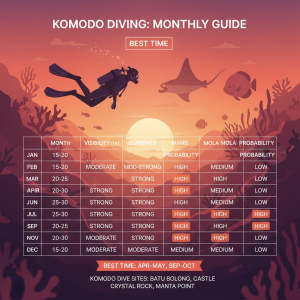
The optimal window is during the dry season, from May to September. During these months, the prevailing currents flow south, visibility in the north is at its peak (often 30+ meters), and surface conditions are generally calm, making for smooth sailing.
What level of dive certification is required?
Due to the powerful and often unpredictable currents, a minimum of an Advanced Open Water certification with at least 50 logged dives is highly recommended. Experience with drift diving, deploying a surface marker buoy (SMB), and comfort in challenging conditions are essential for safety and enjoyment.
How much does a luxury liveaboard trip cost on this route?
For a premium, all-inclusive 8 to 10-day North-to-South itinerary on a vessel like the Sequoia or Amandira, prices typically range from $6,000 to over $10,000 per person. This cost reflects the quality of the vessel, the expertise of the crew and dive guides, gourmet cuisine, and smaller guest-to-guide ratios.
Are there alternatives to the North-South route?
Yes. During the wet season (roughly November to March), the currents shift, and operators run a South-to-North route to take advantage of the conditions. Additionally, shorter 4 to 6-day trips are available year-round, but these typically focus only on the central park area and miss the unique environments of the extreme north and south.
The North-to-South passage through Komodo is more than a dive trip; it is a grand oceanic narrative. It’s a journey that begins with the heart-pounding action of the north, transitions through the kaleidoscopic biodiversity of the center, and culminates in the majestic, cooler sanctuaries of the south. This route, dictated by the ancient rhythm of the tides, offers the most complete and profound way to witness one of the last truly wild places on Earth. To embark on this voyage is to understand the power and fragility of the marine world in its most potent form. When you are ready to experience this definitive adventure for yourself, explore our curated komodo diving package to find the vessel and itinerary that will define your journey.