Updated: May 2026
Best Komodo Scuba Trips for Advanced vs. Beginner Divers
- Beginners: Focus on sheltered sites in Central Komodo with minimal current, typically via day trips or specific liveaboard routes.
- Advanced Divers: Seek out liveaboards heading to the challenging drift dives of North and South Komodo, known for strong currents.
- Key Factor: The choice between a land-based day trip and an all-inclusive liveaboard fundamentally defines the scope and intensity of the dive experience.
The phinisi’s ironwood hull hums beneath your feet, a steady rhythm against the glassy sea. Morning light fractures across the volcanic silhouette of Padar Island, and the air, thick with salt and the faint, sweet scent of clove from the crew’s cigarettes, feels electric. You are gliding through the heart of the Lesser Sunda Islands, a realm where dragons roam and the ocean floor teems with a biodiversity so profound it feels prehistoric. This is the overture to diving in Komodo National Park, an experience that demands respect and careful planning. The question isn’t whether to come, but how to approach its powerful, life-altering waters. The answer depends entirely on one thing: your experience level.
Understanding the Komodo Current: The Park’s Defining Force
Before a single fin hits the water, every diver must understand the force that shapes every underwater moment here: the current. Komodo sits at a critical global chokepoint for oceanic circulation. It’s where the immense volume of the Pacific Ocean is funneled south into the Indian Ocean through deep, narrow straits. This phenomenon, known as the Indonesian Throughflow, moves an average of 15 million cubic meters of water per second. To put that in perspective, it’s the equivalent of about 6,000 Amazon Rivers combined. When this colossal force meets Komodo’s complex underwater topography of pinnacles, channels, and seamounts, it creates some of the most exhilarating—and potentially hazardous—diving conditions on Earth. Currents can easily exceed 8 knots, faster than most divers can swim. This is not a gentle river; it is an oceanic expressway. As our lead divemaster, a Flores native named Anton, explained to me over a Bintang on our last expedition, “You don’t fight the current in Komodo. You join its dance. But you must know the steps before you take to the floor.” This is why a one-size-fits-all approach to a Komodo trip is not just impractical; it’s irresponsible. The best komodo scuba trips are those built on a deep understanding of these hydrodynamics, with itineraries that place divers in the right place at the right time, according to their abilities.
The Beginner’s Itinerary: Mastering Buoyancy in Central Komodo
For those with a new PADI Open Water certification or fewer than 30 logged dives, Komodo’s reputation can be intimidating. But the central region of the park offers a collection of world-class sites that are remarkably protected from the main thrust of the throughflow. A well-designed beginner’s trip focuses exclusively here. Sites like Siaba Besar, affectionately nicknamed “Turtle Town,” provide a perfect training ground. Here, divers can descend to a shallow, sandy bottom around 10-15 meters to encounter dozens of green sea turtles grazing on seagrass. The currents are typically negligible, allowing for relaxed exploration and a focus on perfecting buoyancy. Another excellent introductory site is Sebayur Kecil, a gently sloping reef where you can drift lazily past immaculate hard coral gardens, spotting crocodile fish and schools of fusiliers. Even the famous Pink Beach (Pantai Merah) offers a sheltered reef dive that is accessible to all levels. A typical day trip from Labuan Bajo, the bustling port town on Flores, costs between $150 and $250 and will visit two or three such sites. For a more immersive experience, some liveaboards offer 3-day/2-night curated itineraries that remain in the central park, providing a taste of the liveaboard life without the advanced challenges. On these trips, instructor-to-diver ratios are key; expect no more than four certified divers per guide, ensuring personalized attention and safety.
For the Advanced Diver: Navigating Komodo’s Legendary Drift Dives
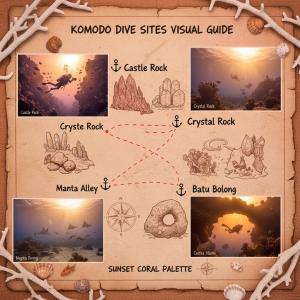
This is the Komodo of legends. For the diver with an Advanced Open Water certification and, ideally, more than 100 logged dives, the park’s northern and southern extremities offer an adrenaline-fueled spectacle unlike any other. These sites are the reason seasoned divers speak of Komodo in hushed, reverent tones. Take Batu Bolong, a rock pinnacle that pierces the surface in the Linta Strait. Below the water, it is a fortress of life, its walls protected from the current that rages past on either side. Descending into the “lee” side feels like entering a stadium of marine activity, with giant trevallies, dogtooth tuna, and whitetip reef sharks patrolling the perimeter. The key is impeccable buoyancy and staying close to the rock. Then there is The Cauldron, also known as Shotgun. Here, divers are propelled through a channel between two islands at high speed, a true underwater flight that culminates in a “bowl” where manta rays often congregate to feed. It requires a negative entry (descending immediately upon hitting the water) and absolute confidence in your skills. Castle Rock, a submerged seamount in the north, is another pinnacle of advanced diving, where divers use reef hooks to anchor themselves to the rock bed and watch a staggering parade of grey reef sharks and schooling barracuda hunt in the current. These are not sites for the timid, and they are almost exclusively accessed via liveaboard, which can position the vessel for optimal tide timings—a critical factor for safety and for witnessing the peak action.
Liveaboard vs. Day Trips: Choosing Your Komodo Basecamp
The decision between a liveaboard and land-based day trips from Labuan Bajo is the most significant logistical choice you will make. It dictates not only which dive sites you can access but the entire character of your trip. Day trips are efficient and cost-effective, perfect for those on a tighter schedule or combining diving with other Flores-based activities. However, they are limited by geography and time. The boat journey to the central park sites takes 90 minutes to two hours each way, consuming a significant portion of your day. You will be restricted to the central, more crowded dive sites. In contrast, a liveaboard is a floating dive resort. These traditional Indonesian phinisi schooners, ranging from comfortable to ultra-luxurious, are your home, restaurant, and dive center for anywhere from 4 to 11 days. The primary advantage is access. A liveaboard can travel to the remote southern sites like Manta Alley or the northern pinnacles like Crystal Rock overnight, allowing you to be the first in the water at sunrise. You can log up to four dives per day, including sunset or night dives, which are impossible on a day trip. This is how you find the best komodo scuba trips; by immersing yourself fully in the park’s rhythm. The experience on a high-end Komodo diving package is unparalleled, offering an all-inclusive journey into the wild heart of the archipelago.
Beyond the Dive: The Luxury Phinisi Experience
For the discerning traveler, the vessel itself is as much a part of the destination as the reefs below. The modern luxury phinisi is a masterpiece of maritime craftsmanship, blending Bugis shipbuilding heritage with contemporary five-star amenities. I recall my last journey aboard the Amandira, where my air-conditioned cabin featured panoramic windows and an en-suite marble bathroom. Days were structured around the tides, but the hours between dives were filled with quiet indulgence. Mornings began with fresh-pressed juices and Balinese coffee on the sun deck as we cruised past deserted islands. Afternoons were for kayaking, paddleboarding, or trekking on Rinca Island to see the Komodo dragons, guided by park rangers who have worked there for over 20 years. The culinary program, led by a chef who trained in Jakarta’s top hotels, was exceptional. We enjoyed multi-course dinners of grilled snapper, beef rendang, and intricate local salads under a canopy of stars, a world away from the lights of Labuan Bajo. This holistic approach transforms a dive trip into a true luxury expedition. These are not merely boats; they are private floating villas, and the finest luxury phinisi liveaboards provide a level of service and exclusivity that redefines marine tourism in Indonesia. It’s an experience curated not just for divers, but for anyone who appreciates impeccable service in one of the world’s last great wildernesses.
Komodo Diving Quick FAQ
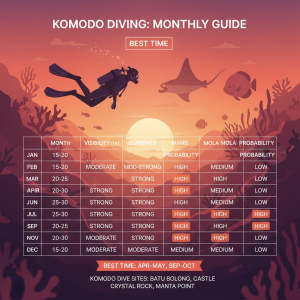
What is the best time of year to dive in Komodo? – The primary diving season runs from April to November during the dry season, offering the calmest seas and best visibility, often exceeding 30 meters. However, the “rainy” season from December to March can be the best time to see manta rays in the central and southern parts of the park, as the plankton-rich waters attract them in large numbers.
Do I need a dive computer? – Absolutely. A personal dive computer is considered mandatory by all reputable operators in Komodo. With multiple dives per day over several days, often at varying depths, tracking your nitrogen loading is essential for safety. Most operators offer rentals for around $10-15 per day, but investing in your own is highly recommended for any serious diver.
What marine life can I expect to see? – The biodiversity is staggering. Komodo is home to over 1,000 species of fish and 260 species of coral. You can reliably expect to see reef sharks (whitetip, blacktip, grey reef), sea turtles, and enormous schools of fusiliers and surgeonfish. The main attractions are the majestic reef manta rays (with a wingspan up to 5 meters) and, for the lucky, occasional sightings of dugongs, dolphins, and even whale sharks.
Is Komodo National Park a protected area? – Yes, and it’s one of the most significant in the region. The park was established in 1980 and designated a UNESCO World Heritage site in 1991 to protect the Komodo dragon. This protection extends to its marine ecosystem, which, according to the official Indonesia Travel portal, covers 1,214 square kilometers of pristine marine environments.
Komodo does not offer a singular experience; it offers a spectrum. From the placid coral gardens of the central park to the thundering currents of its outer limits, there is a journey here for every diver. The key is an honest self-assessment of your skills and a careful selection of the right operator. A trip to these waters is a privilege, a chance to witness an ecosystem functioning at a scale and intensity that has vanished from much of our planet. By choosing an itinerary that respects both your limits and the power of the ocean, you position yourself for an unforgettable adventure. To explore the voyages that best suit your experience, I encourage you to review the expertly curated komodo diving package options we have assembled, each designed to unlock the magic of this remarkable archipelago safely and in unparalleled comfort.