Updated: May 2026
Best Time to Dive Komodo — Month-by-Month Conditions Guide 2026
Komodo Diving Package is a curated Indonesia luxury tourism experience offered by Komodo Divingpackage Atlas: handpicked routes, vetted operators, transparent pricing, and 24/7 concierge support across Indonesia.
- What makes Komodo Diving Package a premium experience.
- How Komodo Divingpackage Atlas curates exclusive access and concierge logistics.
- Routes, seasons, and pricing transparency — no hidden fees.
What Is the Best Time to Dive Komodo?
The best time to dive Komodo is April-November for visibility (25-30m), calm seas and reliable manta sightings; January-March is peak manta-cleaning-station activity at southern sites with cooler 24-26°C water; December and February deliver the lowest crowds but rougher north-site sea state. Komodo is divable year-round — operator availability stays open every month.
“When should I dive Komodo” depends on what you’re optimising — visibility, manta probability, mola-mola odds, currents or crowds. Below, the full month-by-month breakdown so you can match your dates to your priorities.
Komodo’s Two-Season Climate Pattern
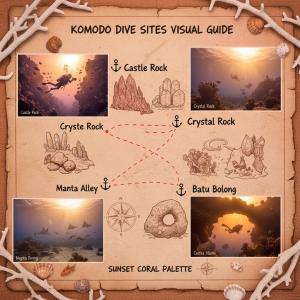
Komodo sits south of the equator in the eastern Indonesia transition zone. Two seasons dominate — dry (April-November, southeast monsoon) and wet (December-March, northwest monsoon). The dry season delivers calmer northern seas and stronger southern swells; the wet flips the pattern, with rougher north-site logistics and calmer south-site access (perfect for manta diving at Manta Alley).
Month-by-Month Conditions Table
| Month | Vis (m) | Currents | Manta | Mola-Mola | Rain | Wind | Operators Open |
|---|---|---|---|---|---|---|---|
| January | 15-22 | Moderate north / calm south | High (south) | Low | High | Moderate | Most |
| February | 18-25 | Moderate | Very high (south) | Low | Highest | Moderate | Most |
| March | 22-28 | Moderate | Very high (south) | Low | Moderate | Decreasing | All |
| April | 25-30 | Mild | High (transition) | Low | Low | Mild | All |
| May | 25-30 | Mild | Moderate | Low | Low | Mild | All |
| June | 28-30 | Mild-moderate | Low-moderate | Possible | Very low | Increasing south | All |
| July | 30+ | Moderate | Low (north windier) | Possible | Very low | Strong south | All |
| August | 30+ | Strong (peak) | Low | Possible | Very low | Strongest south | All |
| September | 28-30 | Moderate-strong | Low | Possible | Very low | Strong south | All |
| October | 26-30 | Moderate | Moderate (transition) | Low | Low | Decreasing | All |
| November | 22-28 | Mild-moderate | Moderate | Low | Increasing | Mild | All |
| December | 18-25 | Moderate | High (south) | Low | High | Moderate-strong | Most (some close mid-month) |
April-June — The Goldilocks Window
If you’re flexible, book April-June. Visibility 25-30m, currents manageable, sea state calm both north and south. Manta activity transitions from peak (Feb-March southern) to moderate (June onwards). Crowds light pre-July school holidays. Pricing low-shoulder, hotels available, our 5D Signature tier averages USD 1,025-1,095/pax in this window.
The downside: late-April still has occasional rain showers, and fishing pelagics at Castle Rock are quieter than peak July-August.
July-September — Peak Currents, Peak Crowds, Peak Pelagic
The Komodo high season. Northern pinnacles deliver their strongest pelagic action — schooling trevally, sharks, big napoleon wrasse — driven by peak current cycle. Visibility 30m+. Surface seas calm in the central park; rougher south of Padar. Crowds peak — Castle Rock can have 4-5 boats simultaneously on a good tide.
Currents at Castle Rock and Cauldron rate 4-5/5 in July-August. AOW + 50 logged dives + Nitrox highly recommended for north-site days. Our package pricing rises 8-12% in this window; hotels book 8-12 weeks ahead.
October-November — The Photographer’s Window
Crowds drop sharply post-September. Visibility holds at 25-30m. Currents soften but pelagic action continues. Manta returns to southern sites in late November as plankton-rich water moves in. October is the quietest month with full operator availability — boats often run at 4-6 divers vs 8-10 in July.
Hotels and dive shops offer late-shoulder pricing — our Signature tier drops to USD 995-1,045/pax. We frequently recommend October as the sweet spot for travellers wanting peak conditions minus crowds.
December-March — Manta Season + Quieter North
The wet season. Rain showers daily (15-30 minutes typically), sea state choppier in the north, but the southern sites — particularly Manta Alley off Nusa Kode — deliver peak manta-cleaning-station activity. Manta sightings at 85-95% probability per dive. Cooler water (24-26°C, vs 28-30°C dry season) brings nutrient-rich currents and plankton blooms.
Visibility 18-25m typical, occasionally as low as 15m on heavy-rain days. Some operators close mid-December to mid-January for crew leave; we partner with shops staying open year-round. Manta-focused divers should book January-March; pricing matches mid-shoulder, our Signature USD 1,025-1,065/pax.
Mola-Mola Probability — Don’t Confuse Komodo with Bali
Important clarification: Mola-mola (Sunfish) sightings are common in Bali (Nusa Penida) August-October but rare in Komodo. Don’t book Komodo expecting Mola; book Bali if Mola is the priority. Komodo’s pelagic stars are reef sharks, eagle rays, manta rays, napoleon wrasse and schooling trevally.
Best Months for Specific Goals
- Best visibility: July-September (30m+)
- Best manta probability: January-March + late December
- Best pelagic action at north pinnacles: July-August
- Best crowd avoidance: October-November + late January
- Best for Open Water divers: April-June (manageable currents)
- Best for AOW + Nitrox + 50+ dives: July-August (full Castle Rock potential)
- Best for honeymoon comfort + diving: May-June or October
- Best for budget: February or November (mid-shoulder)
Avoid These Date Traps
- Indonesian Lebaran (Eid): Jakarta and Bali domestic travel surges 7 days around Eid. Flights to LBJ scarce, hotels booked. 2026 dates: April 1-7 estimated. Confirm with Hijri calendar.
- Christmas-New Year (Dec 22-Jan 5): Western tourists peak with Indonesian local holiday overlap. Most expensive window of the year, hotels +25-40%, boats fully booked.
- Chinese New Year (mid-Feb): Strong Singapore/Hong Kong/Mainland China demand. Book 8-12 weeks ahead.
- School holidays July-August (Australia, EU): Family + youth diver demand peaks. Shore-based packages tighten 8 weeks ahead.
Sea Temperature and Wetsuit Choice
Komodo sea temperature ranges 24-30°C across the year. Most operators issue 5mm wetsuits as standard. We recommend:
- April-November: 3mm full or 5mm shorty for warmer water (28-30°C)
- December-March: 5mm full, hood optional for divers prone to cold (24-26°C in the south)
- Southern sites (Nusa Kode, Manta Alley) any season: 5mm full — southern thermocline drops temperature 2-3°C
Booking Lead Times by Season
| Window | Recommended Booking Lead Time |
|---|---|
| July-August (peak) | 10-14 weeks |
| December 22-January 5 (festive) | 14-18 weeks |
| January-March (manta peak) | 6-10 weeks |
| April-June + October-November (shoulder) | 4-8 weeks (last-minute often available) |
What Happens If Weather Cancels a Dive Day
Tropical storms and high-wind days do occur, especially November-March. Our partner operators reschedule to alternative protected sites (Sebayur, Mawan, Pink Beach all relatively wind-protected). If a full day is unsafe, the dive day is rescheduled within the package or refunded pro-rata at USD 130/lost-day. Travel insurance with weather-cancellation clause recommended.
Match Dates to Plan
Email bd@juaraholding.com with target dates and dive priorities (manta, pelagic, photography, crowd avoidance) — we’ll match the right tier and operator. WhatsApp +62 811 3941 4563 for faster response. Browse our tier breakdown or site guide to finalise.