Updated: May 2026
Is a Komodo Dive Tour Safe for Inexperienced Divers?
- Success depends on operators with certified PADI/SSI instructors and low diver-to-guide ratios.
- Beginner-friendly sites like Siaba Besar offer ideal conditions for skill development.
- Comprehensive dive briefings and adherence to safety protocols are non-negotiable.
Is a Komodo Dive Tour Safe for Inexperienced Divers?
The air is thick with salt and the promise of adventure. Below deck, the gentle thrum of the phinisi’s engine is a steady heartbeat as we glide across the Flores Sea. On the horizon, the saw-toothed silhouettes of volcanic islands—Padar, Rinca, Komodo—rise from the turquoise water like sleeping dragons. You’re here, on the precipice of descending into one of the planet’s most dynamic marine ecosystems. But a question lingers, echoing the concerns of many first-timers to this legendary archipelago: with its reputation for formidable currents, is this underwater realm truly safe for a diver who is still building their confidence?
Understanding Komodo’s Reputation: Currents, Dragons, and Diving Lore
Komodo’s reputation precedes it. Divers speak in hushed, reverent tones about “The Cauldron” or “The Shotgun,” sites where the ocean flexes its immense power. This power is primarily driven by the Indonesian Throughflow, a massive volume of water moving from the Pacific to the Indian Ocean, squeezing through the straits between these islands. This constant flow is the lifeblood of the region, a conveyor belt of nutrients that supports a staggering level of biodiversity. We’re talking about a marine sanctuary that is part of the Coral Triangle, home to over 1,000 species of fish and more than 260 species of reef-building coral. It’s this very intensity that makes Komodo a bucket-list destination. I discussed this duality with Adi Saputra, a cruise director with 15 years of experience logging over 5,000 dives in the park. “Komodo demands respect, not fear,” he explained over a satellite call from his vessel near Gili Lawa. “A new diver’s safety isn’t about avoiding the current; it’s about understanding it. We don’t fight it. We choose sites where we can drift with it gently or find shelter behind a coral bommie. The key is local knowledge.” This ecosystem’s global importance was formally recognized in 1991 when Komodo National Park was designated a UNESCO World Heritage site. The challenge, therefore, isn’t to tame Komodo, but to partner with an operator who knows how to navigate its moods with an expert hand.
The Novice Diver’s Itinerary: Navigating North and Central Komodo
The secret to a safe and enjoyable experience for an inexperienced diver lies in the itinerary. A well-designed Komodo diving package will carefully curate a route through the northern and central sections of the park, which offer a world of wonder without the high-voltage currents of the south. While the southern sites are a siren’s call for seasoned divers seeking pelagic action, the central and northern areas provide a more protected and predictable environment. Dive sites like Sebayur Kecil and Siaba Besar (affectionately known as “Turtle Town”) are perfect examples. These locations feature gentle, sloping reefs and large sandy patches, ideal for buoyancy practice and relaxed exploration. At Siaba Besar, it’s not uncommon for a diver’s first Komodo experience to involve sharing the water with a dozen green and hawksbill turtles. The maximum depths here are typically around 18-20 meters, well within the limits of an Open Water certification. “For a new diver, Wainilu is a treasure hunt,” Adi notes. “The current is negligible, but the macro life is incredible. We find ghost pipefish, frogfish, and blue-ringed octopus. It proves that ‘easy’ diving is not ‘boring’ diving.” A typical 3-day/2-night liveaboard aimed at novices will focus exclusively on these sheltered bays, ensuring every descent builds confidence rather than testing limits. The experience is about immersion and discovery, not adrenaline and endurance.
Choosing Your Vessel: The Critical Role of the Liveaboard Operator
In Komodo, your safety is directly proportional to the quality of your operator. The boat you choose is more than just accommodation; it is your life-support system in a remote wilderness. The question “is a komodo dive tour safe” is best answered by vetting the operator. I spoke with Isabella Rossi, a Geneva-based travel consultant who charters private phinisis in Indonesia. Her advice is unequivocal. “Never book on price. The premier operators invest heavily in three areas: crew, equipment, and protocols.” Look for a divemaster-to-diver ratio of no more than 1:4 for inexperienced groups. This ensures personalized attention underwater. Verify the operator’s credentials; a PADI 5-Star Dive Resort or SSI Diamond Instructor Training Center designation is a reliable indicator of high standards. Onboard safety equipment is non-negotiable. This includes well-maintained Bauer compressors with regularly checked air quality, a 50-liter DAN-standard oxygen kit, comprehensive first aid supplies, and reliable communication systems like VHF radio and a satellite phone. A critical, often-overlooked element is the quality of the pre-dive briefings. A proper briefing should last 10-15 minutes, covering not just the potential marine life, but detailed topographical maps of the site, entry and exit procedures, and specific instructions on navigating the expected currents. This is where a seasoned guide’s value becomes apparent. They can tell you precisely which coral head to shelter behind if the current picks up. A well-curated Komodo dive tour is transparent about these safety measures, often detailing them on their website or in their booking materials.
The Certification Question: Open Water vs. Advanced Open Water
A frequent point of anxiety for new divers is whether their Open Water certification is sufficient for Komodo. The answer is a definitive yes. The standard PADI or SSI Open Water Diver certification qualifies you to dive to a maximum depth of 18 meters (60 feet). A significant portion of Komodo’s most vibrant coral gardens and marine life congregates in the 10 to 20-meter range, making it perfectly accessible. Sites like Tatawa Besar and Batu Bolong, two of the park’s most famous locations, have spectacular coral coverage starting at just 5 meters. While a drift dive at Tatawa Besar requires good buoyancy, a skilled guide can lead a novice group along the sheltered side of the reef, offering all of the spectacle with none of the stress. For those looking to enhance their skills, many luxury liveaboards offer the opportunity to complete the Advanced Open Water (AOW) course during the trip. This is an exceptional way to elevate your diving abilities in a world-class environment. The AOW certification typically involves five adventure dives, including a deep dive to 30 meters and an underwater navigation dive. Completing this onboard, under the tutelage of an experienced instructor, is perhaps the best way to prepare for more challenging sites later in your diving career. This add-on usually costs between $350 and $450 and transforms a vacation into a significant milestone in your diving journey. An advanced Komodo dive package can even be tailored to include this certification seamlessly within the itinerary.
Beyond the Dive: Surface Safety and Island Excursions
A safe Komodo tour extends beyond the underwater portion of your trip. Onboard a liveaboard, the time between dives, known as the surface interval, is critical for off-gassing nitrogen and rehydrating. Reputable operators enforce mandatory surface intervals of at least 60 minutes and strongly encourage constant hydration. Dehydration significantly increases the risk of decompression sickness, a detail that a top-tier crew will remind you of frequently. Sun exposure is another serious consideration; the equatorial sun is intense, and quality vessels provide ample shaded areas for relaxation. The adventure also includes iconic land-based excursions. The trek to the viewpoint on Padar Island, typically done at sunrise, requires sturdy footwear and a moderate level of fitness. The highlight for many is the visit to Rinca or Komodo islands to see the Komodo dragons. These encounters are always led by trained and certified park rangers. Their instructions are simple but vital: stay with the group, keep a minimum distance of 5 meters from any dragon, and never make sudden movements. These rangers are not just for safety; they are a font of knowledge about the dragons’ biology and the island’s unique ecology. The official guidelines provided by Indonesia’s tourism board emphasize the importance of respecting this protected environment, ensuring that the experience is safe for both visitors and the resident wildlife.
Quick FAQ: Your Komodo Diving Questions Answered
What is the minimum number of logged dives required?
For beginner-friendly itineraries focusing on North and Central Komodo, most operators simply require a valid Open Water certification. While some may prefer 10-20 logged dives for comfort, many are equipped to handle freshly certified divers, provided this is communicated during booking. Always confirm the operator’s specific policy.
Is travel and dive insurance mandatory?
Absolutely. Reputable liveaboards will not allow you to board without proof of a comprehensive insurance policy that specifically covers scuba diving activities. Ensure your plan includes hyperbaric chamber treatment and emergency medical evacuation to a depth of at least 30 meters, as standard travel insurance often excludes what they deem “hazardous sports.”
What is the best time of year for inexperienced divers to visit Komodo?
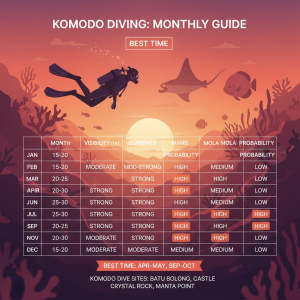
The primary diving season runs from April to November. For the calmest conditions, consider the shoulder months of April-June and September-November. These periods typically offer glassy seas, excellent visibility (often exceeding 30 meters), and fewer boats in the park compared to the peak season of July and August.
Can I dive with a pre-existing medical condition?
All divers are required to complete a standard medical questionnaire before the trip. If you answer “yes” to any of the conditions listed (such as asthma, heart conditions, or epilepsy), you must obtain written clearance from your physician. Transparency about your health is paramount for your safety and the safety of the crew.
Ultimately, Komodo’s powerful reputation should be a source of respect, not deterrence. For the inexperienced diver, the archipelago is not an impassable fortress but a series of gateways, each leading to wonders that can be unlocked with the right key. That key is a meticulously planned komodo diving package, one that prioritizes expert guidance, a conservative itinerary, and an unwavering commitment to safety protocols. When these elements are in place, the question is no longer “if” you can dive Komodo, but “when.” For those ready to descend into one of the planet’s most vibrant marine ecosystems, the journey begins with choosing a voyage that matches your skill level, allowing the magic of this UNESCO World Heritage site to unfold safely and spectacularly before your eyes.