Updated: May 2026
The Best Time of Year for a Premium Komodo Diving Trip
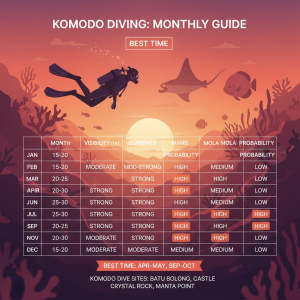
- Seas are generally calm with minimal rainfall, ensuring smooth sailing and comfortable surface intervals.
- Underwater visibility is at its peak, frequently exceeding 30 meters, especially from June to September.
- This window aligns with the prime season for manta ray aggregations at key cleaning stations.
The current, a powerful and life-giving force, guides you along a vertical wall encrusted with a kaleidoscope of hard and soft corals. A school of yellow-masked angelfish, hundreds strong, parts before you. Sunlight filters down through 30 meters of impossibly clear water, illuminating the scene with an ethereal glow. In the blue, a shadow detaches itself from the depths—the unmistakable diamond shape of a reef manta ray, gliding effortlessly toward a cleaning station. This is not just a dive; it is a moment of total immersion in one of the planet’s most dynamic marine ecosystems. Timing this encounter, this perfection, is not a matter of luck. It is a matter of precision planning, the core of any truly premium Komodo diving trip.
Deconstructing Komodo’s Two Distinct Seasons
Komodo National Park, a UNESCO World Heritage site sprawling across 1,733 square kilometers, is governed by two monsoon seasons, not four distinct ones as in the temperate world. Understanding their specific characteristics is fundamental to curating an elite diving experience. The dry season, running from April to November, is what most consider the “main” season. It is defined by consistent south-easterly winds and minimal precipitation. This period delivers the postcard image of Komodo: calm, glassy seas, particularly in the northern and central parts of the park, and exceptional water clarity. Visibility can reliably reach 30 meters and, on exceptional days, push toward an incredible 40 meters. However, it also brings a significant oceanographic event: nutrient-rich upwellings from the deep Indian Ocean cool the southern waters considerably. While the north remains a balmy 27-29°C, sites in the south, like Manta Alley and Padar, can see temperatures drop to a brisk 20-24°C. This temperature differential is precisely what makes the ecosystem so vibrant, fueling the plankton blooms that attract megafauna. It is the definitive season for liveaboard journeys, allowing vessels to navigate the entire park in comfort. Conversely, the wet season, from December to March, is characterized by north-westerly winds and heavier, though often short-lived, rainfall. The seas, especially in the south, can become challenging, limiting access to certain exposed dive sites. Underwater visibility typically reduces to a still-respectable 15-20 meters. While some operators pause during the peak of the wet season in January and February, this period offers its own unique advantages for the intrepid traveler: the islands are transformed into a landscape of verdant, rolling hills, and with fewer than half the number of boats in the park, a profound sense of solitude prevails.
The Peak Season Sweet Spot: June through September
For those seeking the quintessential Komodo experience, the four-month window from June to September represents the absolute apex. This is the heart of the dry season, where all environmental factors align to produce truly world-class diving conditions. The primary draw is the peak of manta ray season. The cold-water upwellings are at their strongest, creating a plankton-rich soup that draws dozens of oceanic and reef manta rays to renowned cleaning stations. At sites like Karang Makassar (Manta Point) and Mawan, divers can witness one of nature’s great spectacles, observing these gentle giants as they queue and hover, being serviced by cleaner wrasse. It is not uncommon for encounters to involve 10 or even 20 individual mantas on a single dive. Beyond the mantas, the surface conditions are at their most placid, making for effortless travel between the park’s 29 islands. This is particularly crucial for a premium komodo diving trip, where comfort and safety are paramount. The calm seas allow liveaboards to moor in serene, protected bays, offering uninterrupted views and tranquil nights. On land, this period coincides with the Komodo dragon mating season (typically July and August). The world’s largest lizards, which can grow up to 3 meters in length, are at their most active, often engaging in dramatic territorial disputes. A guided trek on Rinca or Komodo Island during these months offers the highest probability of witnessing this primeval behavior. The trade-off, of course, is popularity. These months see the highest concentration of visitors, but a well-designed komodo diving package mitigates this by utilizing expert guides who know how to time site entries to avoid the busiest periods, ensuring an intimate and exclusive encounter with the park’s treasures.
The Allure of the Shoulder Months: April-May & October-November
While the peak season offers reliability, the shoulder months—April to May and October to November—are what many seasoned Komodo veterans, myself included, consider the connoisseur’s choice. These transitional periods provide a unique blend of benefits, often with a fraction of the crowds. April and May mark the shift from wet to dry season. The lingering effects of the monsoon mean the islands are at their most photogenic, draped in a vibrant, almost iridescent green. The winds are shifting, and the seas are rapidly calming, while the water is still universally warm, hovering around 28°C throughout the park before the southern upwellings take full hold. Visibility improves daily, consistently hitting the 25-meter mark. This is an ideal time for wide-angle photography, capturing the contrast between the lush landscapes and the deep blue of the Flores Sea. Conversely, October and November signal the transition back to the wet season. The strong south-easterly winds have abated, and the water temperature in the south begins to climb again. This period is often exceptionally calm, a brief interlude between the two monsoon patterns. Diving is excellent across the entire park, from the critter-rich black sand slopes of the north to the exhilarating pinnacles of the south. I recall a trip in late October where we experienced mirror-flat seas for seven consecutive days, a phenomenon less common during the windier peak months. These months represent a strategic advantage; you get 90% of the peak season’s benefits with perhaps only 50% of the visitor traffic. It is an excellent time to secure passage on a premier vessel, such as those featured in our Komodo Dive Package Atlas portfolio, often with more flexibility and availability.
Matching the Season to Your Diving Ambitions
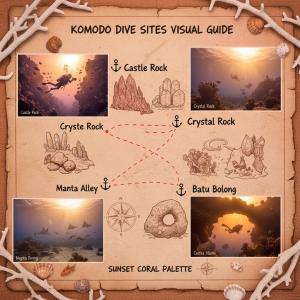
A truly premium journey is tailored. The “best” time to visit Komodo depends entirely on what you, the diver, want to achieve. It’s about aligning the destination’s rhythm with your personal ambitions. For the dedicated manta ray enthusiast, the directive is clear: plan your trip between June and September. This is when the cleaning stations are at their busiest, and the probability of prolonged, multi-individual encounters is highest. If your passion is macro photography and unusual critters, the calculus changes. The wet season, from December to March, can be surprisingly rewarding. The warmer water and slightly lower visibility can bring out different species. Sheltered northern sites like Siaba Besar and Wainilu become havens for ghost pipefish, frogfish, and a dazzling array of nudibranchs. The shoulder months are also superb for macro life. For the adrenaline-seeker drawn to Komodo’s legendary currents, which can exceed 8 knots in channels like the Linta Strait, the season is less critical than the lunar cycle. The currents are dictated by the tides, which are strongest around the new and full moons year-round. However, the calm surface conditions of the dry season make the logistics for high-voltage drift dives at sites like The Cauldron and Batu Bolong safer and more comfortable. For the traveler who values solitude above all, the shoulder months or even a carefully planned wet season trip on a robust vessel offers a chance to experience the park as it was decades ago. Imagine being the only boat moored off Gili Lawa Darat for sunset—a priceless luxury that strategic timing can afford.
Beyond the Dive: Surface Conditions and Terrestrial Life
The Komodo experience extends far beyond the reef’s edge. A significant portion of any luxury liveaboard itinerary is spent above the water, and the season dramatically influences these moments. During the peak dry season from June to September, the landscape takes on a stark, savanna-like beauty. The hills of Padar, Komodo, and Rinca are burnished gold and brown, creating a dramatic, prehistoric backdrop for the iconic pink-sand beaches. This is the optimal time for trekking. The trails are dry and firm, and as mentioned, the Komodo dragons are at their most active and visible. The air is less humid, making the hike to Padar’s famous viewpoint a more comfortable endeavor. According to the official travel portal for Indonesia, this is the most popular time for land-based excursions. In contrast, the wet season and early shoulder months (April-May) present a different but equally compelling aesthetic. The islands are lush and intensely green, a visual feast for photographers. Waterfalls that are dormant for most of the year may reappear, and the air is filled with the scent of damp earth and blooming flora. While trekking can be more challenging due to muddy paths, the vibrant scenery offers a powerful reward. The dragons, while perhaps less active in the heat of the day, can still be readily found by experienced local guides. Choosing a season is also about choosing your preferred landscape, a decision that shapes the entire narrative of your journey through this ancient archipelago, whose marine ecosystem is driven by massive oceanic currents like the Indonesian Throughflow.
A Quick FAQ for Planning Your Komodo Expedition
What are the water temperatures I should expect in Komodo? The park has two distinct thermal zones. Northern and central sites remain a consistent 27-29°C (81-84°F) all year. However, during the dry season (June-September), southern sites can dip to 20-24°C (68-75°F) due to deep-water upwellings. We recommend a 5mm wetsuit with an optional hood or vest to be comfortable in all areas.
Do I need to be an advanced diver to enjoy Komodo? While there are many calm, protected sites suitable for all levels, Komodo’s reputation is built on its currents. To fully and safely experience the signature dive sites like Castle Rock or Batu Bolong, most premier liveaboards require an Advanced Open Water certification and a minimum of 50 logged dives.
How far in advance should I book a premium liveaboard? For the peak season months of June through September, it is standard practice to book 9 to 12 months in advance, especially for the most sought-after vessels and private charters. For the shoulder seasons, a 6 to 9-month lead time is advisable to secure your preferred dates and cabin.
Is Komodo National Park open all year? Yes, the park itself is open 365 days a year. However, during the height of the wet season, typically in January and February, rough sea conditions can make the southern region of the park inaccessible for safety reasons. Most liveaboard operators will adjust their itineraries to focus on the excellent and more sheltered northern and central sites during this time.
Timing is the invisible thread that weaves together the elements of an extraordinary journey. In a place as dynamic as Komodo, arriving in the right month transforms a great dive trip into a life-altering experience. It is the difference between seeing a manta ray and witnessing a ballet of them, between a pleasant boat ride and a seamless voyage through a primeval world. The currents of Komodo wait for no one, but our team can ensure you are in the right place at precisely the right time. Explore our portfolio of meticulously curated komodo diving package options to begin crafting your own definitive Indonesian adventure.